
Resources · Getting started
What does a paediatric occupational therapist actually do?
The name doesn’t help us much. When people hear “occupational therapy”, many think of jobs and workplaces, and then wonder why a child would need it. So let me explain what I actually do.
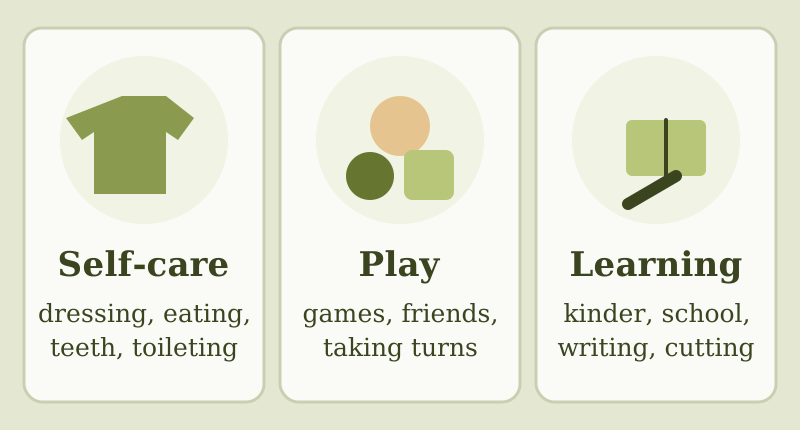
A child’s “occupations” are their everyday life
For a child, the day is made up of looking after themselves, playing, and taking part at kinder or school. Occupational therapists help children take part in these everyday activities that matter to them. [1]
Your child, the task and the place
When something is hard, I try not to assume the problem sits inside the child. What your child can do depends on three things working together, and we can make changes to any of them. [1]
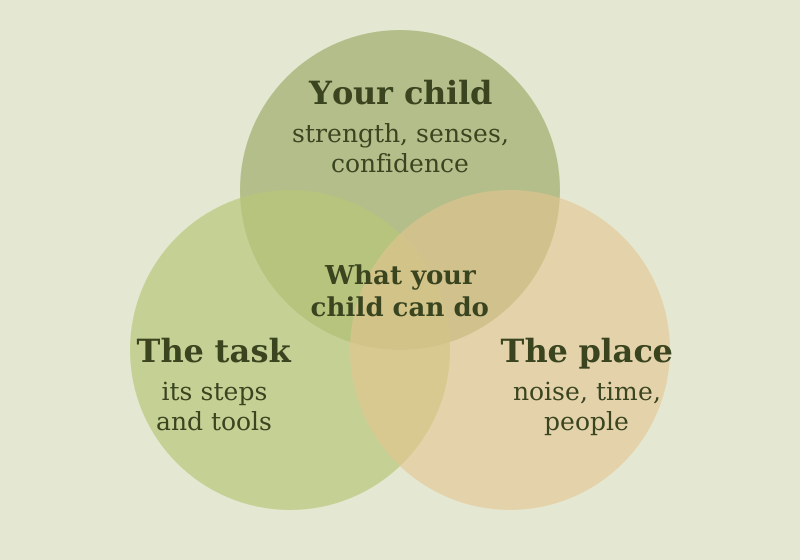
Take a school shirt with tricky buttons. Looking at your child, we might use play that works the fingers. Looking at the task, we might start with the bottom button, or try larger buttons. Looking at the place, we might practise on a calm weekend, not in the rush before school.
Why it can look like “just playing”
Play is a big part of a child’s day, so many activities in a session are built from play. There’s usually more going on than you might first see.
| What you might see | What the activity asks of your child |
|---|---|
| Squeezing and rolling playdough | The muscles of the hands and fingers |
| Putting stickers on paper taped to a wall | Using the arms, hands and fingers together |
| Picking up pompoms with tongs | Pinching and fine hand control |
| Playing a board game | Taking turns, waiting, and coping with losing |
You’re part of it
You know your child best. We choose goals together, and I’ll share ideas that fit into your family’s day, so you’re not adding a long list of homework. With your permission, I can also talk with your child’s kinder or school, so everyone is working from the same plan. Working alongside parents in this way, especially when setting goals, is a recurring feature of paediatric occupational therapy research [2].
Every child develops at their own pace, so this isn’t a test your child needs to pass. You don’t need a diagnosis or a referral to contact me.
References
- Law M, Cooper B, Strong S, Stewart D, Rigby P, Letts L (1996). The Person-Environment-Occupation model: a transactive approach to occupational performance. Canadian Journal of Occupational Therapy, 63(1), 9–23
- Lage et al. (2024). Collaborative practice with parents in occupational therapy for children: a scoping review. Australian Occupational Therapy Journal, 71(5), 833–850
This article is general information. It is not advice about your own child. Talk to your GP or another health professional about any health concern.