
Resources · Family life
More than “good job”: ways to encourage your child
“Good job” comes out of all of us, many times a day, and there’s nothing wrong with it. The trouble is only that it doesn’t tell a child what you valued. Being a little more specific takes a few extra words, and it shows your child that you were really watching.
A simple recipe
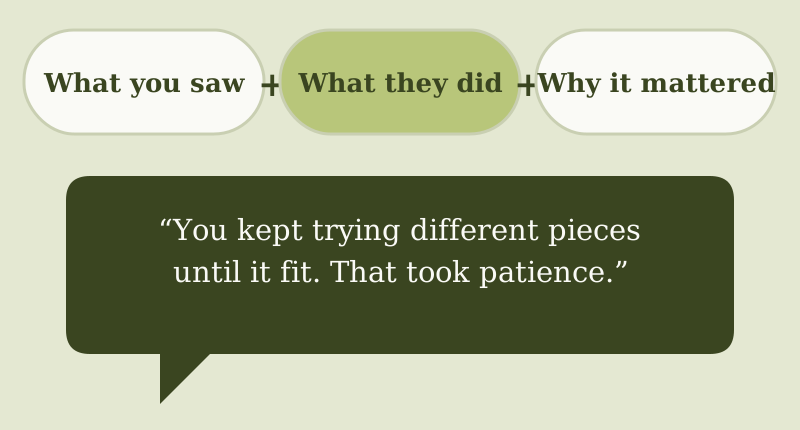
Research on praise is mixed, and no one phrase works for every child. One review found that praise can raise, lower or have no effect on children’s intrinsic motivation, depending on how it is given [3]. In a study that followed 53 families, toddlers whose parents praised effort and choices were more likely to hold a growth-oriented view of ability at age 7 to 8 [1]. In experiments with fifth-graders, praise for intelligence was linked with doing worse after a setback than praise for effort [2].
Swaps to try
| Instead of | You could try |
|---|---|
| “Good job!” | “You put your shoes on all by yourself.” |
| “You’re so smart!” | “You tried three ways until that puzzle worked.” |
| “That’s perfect!” | “You used so many colours in that sky.” |
| “Good girl.” or “Good boy.” | “Thank you for holding the door. That really helped.” |
| “You’re better than your brother at this.” | “Look, you’ve worked it out!” |
Other ways to show you noticed
A few things to go easy on
- Big words like “perfect” or “incredible”. In one study, this kind of praise backfired for some children [4].
- Praising things your child already loves doing. Praise can change how some children feel about an activity they enjoyed for its own sake [3].
On the hard days
Encouragement doesn’t depend on success. When the tower falls or the test goes badly, your child doesn’t need a speech. “That was really hard, and I’m here” may be enough. What I try to encourage is noticing your child as they are, and not only when things go well.
If you’d like to talk about what encouragement could look like in your family, you’re welcome to get in touch.
References
- Gunderson EA, Gripshover SJ, Romero C, Dweck CS, Goldin-Meadow S, Levine SC (2013). Parent praise to 1- to 3-year-olds predicts children’s motivational frameworks 5 years later. Child Development, 84(5), 1526–1541
- Mueller CM, Dweck CS (1998). Praise for intelligence can undermine children’s motivation and performance. Journal of Personality and Social Psychology, 75(1), 33–52
- Henderlong J, Lepper MR (2002). The effects of praise on children’s intrinsic motivation: a review and synthesis. Psychological Bulletin, 128(5), 774–795
- Brummelman E, Thomaes S, Orobio de Castro B, Overbeek G, Bushman BJ (2014). “That’s not just beautiful, that’s incredibly beautiful!”: the adverse impact of inflated praise on children with low self-esteem. Psychological Science, 25(3), 728–735
This article is general information. It is not advice about your own child. Talk to your GP or another health professional about any health concern.