
Resources · Feelings at home
Body signals: helping your child notice hunger, tiredness and big feelings

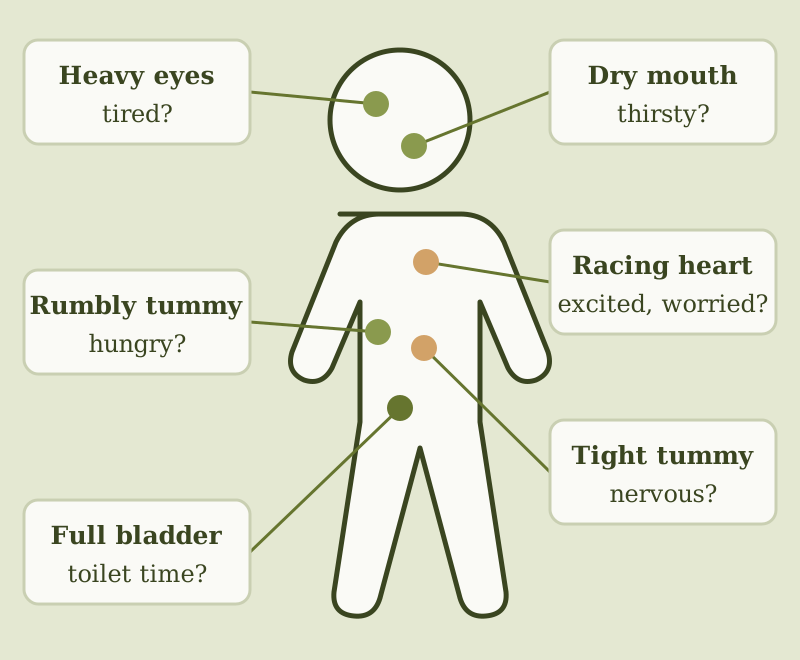
Most of us know the five senses. There’s another one that’s easy to miss, called interoception (in-ter-oh-SEP-shun). It’s the sense that tells you what’s happening inside your body: hungry, thirsty, hot, tired, or needing the toilet [1].
Why it matters
Our bodies and our feelings are closely linked. Worry might feel like a tight tummy. Researchers have linked the sense of the body’s inner state with emotion [1, 3], which is why you may hear about it in schools and in occupational therapy. A recent scoping review of interoception in children’s occupational therapy found the evidence is still developing [2], so I see these as gentle ideas to try and not a set program.
Body signals can feel different from one person to the next. In one study of autistic adults, accuracy at detecting their own heartbeat was lower on average than in non-autistic adults, even though the autistic adults rated themselves as aware of their body signals [3]. That study was of adults, and this area is still being researched.
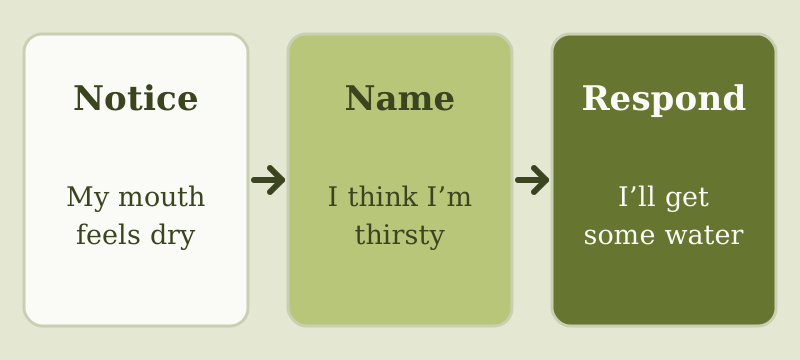
Notice, name, respond
Here is one way I think about it, as three small steps. It’s a practical idea and not a tested program.
Ideas to try at home
- Say your own signals out loud: “My mouth is dry and it’s hot today. I’ll have some water.”
- After running or jumping, put a hand on your chests and feel your hearts beating fast, then slowing down.
- Compare warm hands and cold hands after a bath or a play outside.
- Draw around your child on a big sheet of paper, and mark where they feel things.
- Talk about big moments later, when everyone is calm.
- Use outside reminders if they help, like a drink before leaving school. Older children may prefer something quiet, such as a phone or watch reminder.
| Instead of | You could try |
|---|---|
| “You’re fine.” | “Your shoulders look tight. What do you notice?” |
| “You can’t be hungry.” | “What’s your tummy telling you?” |
| “Calm down.” | “Your breathing is fast. Let’s slow it down together.” |
For any pain or a change in toileting, start with your GP so physical causes can be checked. If you’d like to talk about the everyday side of body signals, you’re welcome to contact me.
References
- Craig AD (2002). How do you feel? Interoception: the sense of the physiological condition of the body. Nature Reviews Neuroscience, 3(8), 655–666
- Clark E, Brown T, Yu M-L (2025). Interoception and its application to paediatric occupational therapy: a scoping review. Australian Occupational Therapy Journal, 72(1), e12997
- Garfinkel SN et al. (2016). Discrepancies between dimensions of interoception in autism: implications for emotion and anxiety. Biological Psychology, 114, 117–126
This article is general information. It is not advice about your own child. Talk to your GP or another health professional about any health concern.